Search Death Records (United States)
 U.S. Newspapers, 50 State Full Search (1690-present)
- U.S. Obituary Database Search, (1696-present)
- U.S. Birth Announcements Database, (1700s-present)
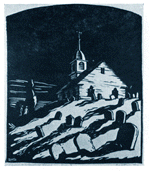 SavingGraves.com:
Bill Spurlock
SavingGraves.com:
Bill Spurlock
By Steve Paul Johnson, October 6, 2000
Bill Spurlock has been caring for cemeteries since he was a child. His regard for them has led to the creation of "SavingGraves.com" a website focusing on protection and restoration of cemeteries.
Since its inception, SavingGraves has become like a worldwide "clearing house" of endangered cemetery reports. Month-after-month, people submit reports of endangered cemeteries to the site, and Bill posts them online and coordinates them with people and organizations best suited to take action.
I hooked up with Bill and asked him some questions:
Steve: What is "Saving Graves"?
Bill: Saving Graves is the leading Internet presence in the battle for the protection, restoration and preservation of endangered cemeteries worldwide.
Steve: How did you get into this?
Bill: This is an issue that I've been exposed to all my life. As a boy, my family would makes several long weekend trips a year from our home in Michigan down to Allen County, Kentucky where my Dad was born. My dad always made it a point to spend what little time we could at the small family cemetery located in the middle of a farm, where his mother's relatives were buried. We always took the time to do what cleaning and upkeep on the cemetery that we could and this made a huge impression on me. One that has stuck with me all my life. Saving graves itself was started when in searching for some information, I discovered much to my amazement that there was no single resource on the internet that was providing comprehensive information in this area. There were a number of sites that might focus on specific areas or issues, but there was not a single source for someone to turn to as a good starting point for an overall search. I was inspired by a number of these websites, to start the original concept behind Saving Graves. Some sites that comes to mind that was a great inspiration was the wonderful work that Lois Mauk has done with the Indiana Pioneer Cemetery Restoration Project and the Save Our Old Cemeteries website that was run out of Oklahoma.
Steve: How do people benefit from Saving Graves?
Bill: Well, It's fast become somewhat of a portal website for cemetery preservation issues and it's interesting that the main pages traffic is not a good indication of the traffic that the site is taking. I'd say that for every 1 visit that the main page gets, there another 10 to 15 that come into the site from a different page. We've made a real difference so far with the Endangered Cemetery Reports. As a result of people submitting information on a specific cemetery, we have played a part in saving at least three cemeteries, and brought attention to problems that others have been able to step in and assist. One of the biggest things that people benefit from is the fact that we offer a "one stop" website for finding information on just about any location and as more people are learning about the existence of the website more and more are turning to it as a first stop in their search for information.
Steve: How long has Saving Graves been running?
Bill: Saving Graves first started back in Feb of this year on one of the free web space accounts at RootsWeb under the name of Save Our Old Cemeteries, and in March the name was changed to Saving Graves, the domain "savinggraves.com" was registered and the site moved to a larger server.
Steve: Are you the only person running it, or do you have some helpers?
Bill: At the moment it's only me running the website. However, it's fast reaching the point where I cannot do everything that needs to be done on a daily basis and keep the site up to date. For example, I was just recently forced to make a change to the News Center area where rather than attempt to keep up with the daily updated needed I replaced that with links to several news sources. This freed up a little time for me, but as a result the site lost the ability to have an "archive" of past stories. Visitors are still getting the same news from the same sources, but I'm no longer updating that area by hand.
Steve: Do you have some means of learning about endangered cemeteries, or do you rely solely on your visitors?
Bill: For the most part, I've been relying on the sites visitors to inform me of the endangered cemeteries. The primary source for this is, of course, the Endangered Cemetery Reports, but at the same time many people will email me to let me know about a specific situation. However, over the last month as the site has been becoming more known I find that I'm getting numerous contacts from reporters working on stories involving cemetery issues. For example, I did a series of interviews on a situation currently taking place in Michigan involving the clean up of a neglected cemetery that had I not been contacted by a reporter from The Detroit News I would never have known about.
Steve: If I learn that a cemetery is being destroyed, how do I get that information on Saving Graves?
Bill: By far the best thing you can do is to submit an Endangered Cemetery Report on the situation. This will get the information to me quickly, and the report form has been designed to get all of the needed information not only to me, but to the others that I'll contact regarding the situation.
Steve: Does Saving Graves normally take action when it receives news of an endangered cemetery?
Bill: Yes, what I do is upon receiving an Endangered Cemetery Report the first thing that I want to do is to get that report online in as quick a time as possible. I tell people that they can expect it to take upward of 3 days under normal conditions, but in all reality I try to make every attempt to get the report live in under 24 hours. Once the report is live, I then have a form letter that the report is included as a part of that introduces Saving Graves and goes into a little detail on what it's doing, and why they have been contacted. This letter will go out by email to any number of people or groups that are in a position either to directly assist in the situation, or can direct the report to those that can. Where possible, these letters will go out to various law enforcement agencies, the state Attorney Generals office, State, County and local historical or Genealogical societies, and the like.
Steve: How does one go about gaining protection of an endangered cemetery?
Bill: Good question, and one that is nowhere near as simple as you might think. The obvious answer is to make use of the various laws in your given state where possible, keeping in mind that the laws of every state are vastly different and not all states have laws regarding the various different problems that I see come up on a daily basis. But the real problem that stand out far and above anything else is that fact that in many, many cases it's not the lack of a law but getting that law enforced. There are a number of reasons as to why the laws are not enforced, but every day I am informed of this taking place. The best example that I can give you is one that I use quite often involving the sheriff of Adair County, Kentucky who when presented with a situation that was without question in violation of Kentucky state law responded by stating "This is MY county and I make the laws here." In order to really get the protection of your cemetery you have to be willing to fight for it. You have to be willing to spend a great deal of time, energy and in some cases money. You have to be willing to go directly to your State Attorney Generals office for help. You have to be willing to bring the situation to the attention of the media. One of the things that I am most proud of is in this short amount of time that I've been doing this, Saving Graves has played a part in saving no less than 3 endangered cemeteries around the Untied States that I am aware of. It has also had a influence in new laws in several states and more to come next year. It is making a difference, but it's only one small part of the entire process. It involves a partnership of many working together to a common goal of saving a vital and irreplaceable part of history.
Steve: What can we expect from Saving Graves in the coming new year?
Bill: The next year looks to be exciting for Saving Graves. Plans currently call for not only adding more nations, but to provide translations of the web site into several additional languages. In the past month, the site has been visited by people from over 50 different nations worldwide. I want to bring more people into it to assist in a number of areas. For example, I'm going to look at getting people in different nations to take over the pages for their countries. Roughly just under 1/3 of our traffic comes from Canada so I'd like to see that area of the site expanded, and they will be one of the first translations that we do.
- Steve Paul Johnson